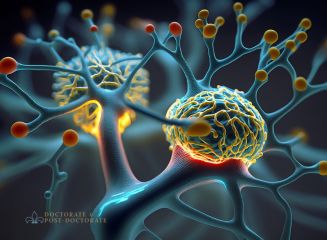
Neuroscience and PhD: Improve your skills, decisions, and critical thinking with
If you are in search of a profound personal transformation, studying for a PhD will not only connect you to an academic goal but will also lead you to a process where you can discover advances in neuroscience that will benefit you in making the best decisions. It will undoubtedly help you with issues such as developing critical thinking and skills to create a lasting, long-term impact, even after you graduate. So stay tuned to this article and find out how.
Neuroscience can be a great ally during your studies, especially at key stages such as reading, writing your thesis, and even coping with uncertain thoughts. Research published in the Journal of Cognitive Enhancement in 2022 showed that students who incorporated cognitive training—such as memory, processing speed, and attention exercises—achieved a 23% improvement in their academic productivity and a 17% reduction in anxiety.
How to include neuroscience in a Ph.D.
The questions asked by people who want to start a PhD at a distance are common to all: When is the right time for a PhD?, Am I going to be able to do it all? It is normal to have doubts if you find yourself with work and family responsibilities and have been away from academic life for a long time. This is the time when neuroscience plays a significant role.
Harvard University conducted and published a study in 2003, which confirms that adult has a brain with amazing capacities to adapt. This is what is currently known as neuroplasticity, which allows people to acquire new cognitive skills, including people between 40 and 50 years old; the limit is not by age, but based on the road they have traveled.
Lately, it has been demonstrated that the process of self-regulated learning, such as online doctoral programs, favors the stimulation of areas of the brain related to planning, motivation, and executive control. That is, when you make the decision to study on your own initiative, your brain reacts and improves with agility and efficiency.
Similarly, it is important to note that according to a report by the World Economic Forum, presented in 2024, 78% of distance learning graduate students over 35 years old believe that studying helps them to improve their ability to make complex decisions.
Neuroscience as a tool to overcome obstacles
When you start a PhD program, new challenges begin: mental fatigue, writing blocks, time management, and cognitive load. This is where neuroscience is your ally.
It is important, when facing these challenges, to rest and sleep, because during deep sleep, learning is consolidated in the brain. Performance is weakened when studying without rest. According to the National Sleep Foundation, adults who have a continuous sleep of at least 7 hours have a 30% higher retention of information.
Therefore, study should be distributed; marathon reading is not recommended. There are even techniques, such as spaced repetition, which consists of reviewing certain information at separate intervals of time, that help the fixation of permanent knowledge. Through neuroscience, you can learn for these short periods of time, because in this way, more synapse connections are activated; otherwise, intensive study at the last minute is not productive.
Decision-making and emotional control are fundamental because during the PhD, it is normal that there may be moments of frustration. It is right there where you should understand that the interaction of the limbic system with the prefrontal cortex will help you make more objective decisions. According to a study in the Journal of Neuroscience Education, it has been shown that the practice of mindfulness has been shown to reduce academic anxiety by 42%.
It is advisable that you organize study blocks alternating with short breaks, combining reflection exercises and applying visual organization tools (mind maps), because the brain processes better when there is variety and structure.
How to apply doctoral knowledge
Finishing a PhD does not mean an end, but an imprint of your continuous learning, which is where you have to take advantage of, to get the full value of what your brain has developed. It has been demonstrated, through neuroscience, that the cognitive skills gained during the graduate study process, such as complex decision-making, self-regulation, and critical evaluation of information, are applicable in the work and personal contexts. Here are some practices to further develop your knowledge and stay connected.
1- Make strategic decisions: The ability to analyze problems in different fields will be of greater impact, whether you are within the private, academic, or public sector.2- Lead with critical thinking: According to a 2022 MIT study, leaders with a doctorate degree are 40% more effective in solving complex ethical dilemmas.
3- Keep your learning constantly updated: According to neuroscience, the brain training in research is more receptive to new knowledge, even many years after the program.
4- Cultivate a continuum with the academic community: This contact is very important because it stimulates the brain areas related to moral reasoning, empathy, and collaboration. With the help of research groups, mentorships, and alumni, you have the opportunity to continue growing and adding value.
The doctorate as a life transformation project
Neuroscience drives and validates the power of learning in adulthood. If you are thinking about starting a PhD at a distance, keep in mind that your brain is ready. You will develop new skills, critical thinking and be able to make better decisions in all aspects of your life.
Remember that the PhD is not only an academic goal, it is a path that you decide to live and that will allow you to have a personal and academic evolution. In addition, neuroscience offers one more reason to leave behind any excuses or doubts.
At the end of your studies, your mind will continue to function with clarity regardless of your age, you will be able to continue with purpose and strategy because learning does not end with the degree, on the contrary, it transforms with you.